Turbinella Oak - Co-Evolution
The Turbinella oak, (Quecus dumosa turbinella), has adapted to living in the Mojave Desert, usually above 4,000 feet where more moisture is available.Early desert people harvested the acorns, grinding them into a coarse flour, Now ground squirrels get first crack, carrying them off for winter meals.
You may see round, pink swellings, called galls, on the branches. A small wasp is responsible. The female wasp lays her eggs on a tree branch. When the eggs hatch, the larvae that emerge secrete a chemical, causing the tree to grow in a facinating, unnatural way. The caterpillar-like larvae feed inside the gall until mature. Then they chew tiny holes to the outside, flying away to repeat the cycle. Oak galls are not harmful to the trees.
< Previous - Next >
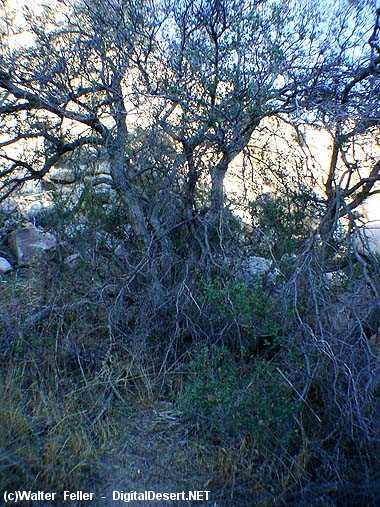
Turbinella oak (Quecus dumosa turbinella)
| Intro:: Nature:: Geography & Maps:: Parks & Preserves:: Points of Interest:: Ghosts & Gold:: Communities:: Roads & Trails:: People & History:: |
|
Digital-Desert :
Mojave Desert
|
|
Country Life Realty Wrightwood, Ca. |
Mountain Hardware Wrightwood, Ca. |
Canyon Cartography |
G.A. Mercantile |
Grizzly Cafe Family Dining |
|
Abraxas Engineering privacy |
For educational use only; not a travel or safety guide. Copyright (c) Walter Feller, 1995-2026. All rights reserved. |