Black-tailed Jackrabbit
Lepus californicusFamily: Leporidae Order: Lagomorpha Class: Mammalia
DISTRIBUTION, ABUNDANCE, AND SEASONALITY
Common throughout the state, except at the highest elevations. Abundant at lower elevations in herbaceous and desert-shrub areas and open, early stages of forest and chaparral habitats.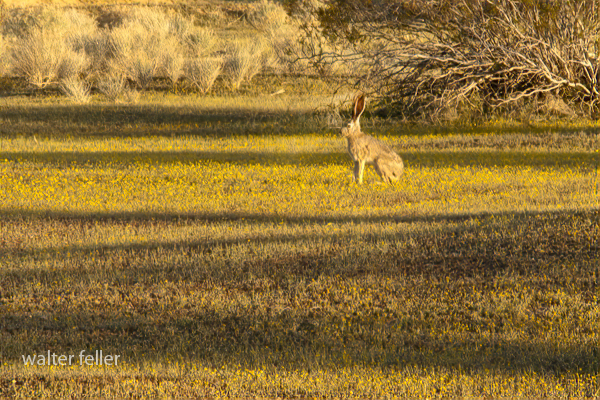
SPECIFIC HABITAT REQUIREMENTS
Feeding: Strictly herbivorous; graze and browse. They prefer grasses and forbs but will eat almost any vegetation that occurs in the area, up to about 51 cm (20 in) above the ground. Chew and Chew (1970) found 65% of the diet was shrub browse, and 30% was herbage. Diet changes with forage availability by season. Coprophagous (Flinders and Hansen 1972).
Cover: Uses shrubs for cover.
Reproduction: Young are born beneath vegetation that provides some overhead cover. As in other hares (Genus Lepus) no special nest structure is built.
Water: Water is not necessary, but it will be drunk if available.
Pattern: Intermediate canopy stages of shrub habitats, and open shrub/herbaceous and tree/herbaceous edges provide suitable habitat.
SPECIES LIFE HISTORY
Activity Patterns: Yearlong diurnal and crepuscular activity.
Seasonal Movements/Migration: Non-migratory.
Home Range: Home ranges in California averaged 18.5 ha (45 ac) (Lechleitner 1958). In Kansas, Tiemeier (1965) estimated home ranges from 4-79 ha (10-194 ac). In Utah, densities have been calculated at 100 per km2 (260/mi2) (Flinders and Hansen 1973).
Territory: Probably not territorial, at least in Kansas (Tiemeier 1965).
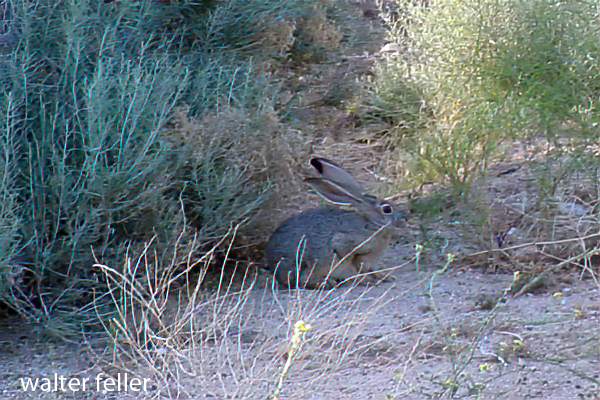
A very pregnant jackrabbit
Reproduction: Breeds throughout the year, with greatest number of births occurring from April through May (Ingles 1965). Gestation period is 43 days. Up to 4 litters of 3-4 young (range 1-8) produced per yr. Young weaned at 3 wks. A yr-old female may produce 14, or more, young per yr (Ingles 1965). Populations may fluctuate in 3-6-yr intervals, and may increase up to 9-fold. This species mostly is solitary, except when mating and raising young.
Niche: Because of their great adaptability, and rapid rate of reproduction, black-tailed hares can become pests. Tularemia, plague, and skin diseases are carried by this species.
Predators include coyotes, eagles, northern harriers, barn owls, red-tailed hawks, great horned owls, rattlesnakes, and gopher snakes. Competitors for food primarily include other grazers and browsers. Also called black-tailed jackrabbit.
Source:
CDFW California Wildlife Habitat Relationships. Accessed [N/A]
https://wildlife.ca.gov/Data/CWHR
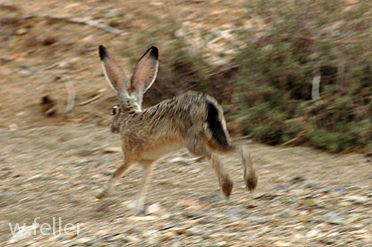
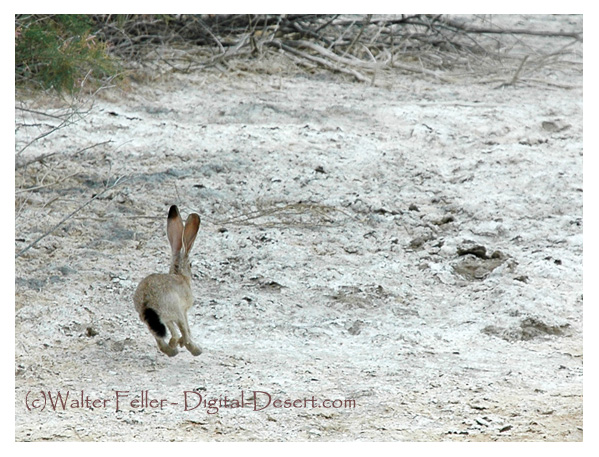
The Black-tailed Jackrabbit is a member of the hare family. Its fur is a dark buff color that is peppered with black. It has distinctive long ears tipped with black.
The Black-tailed Jackrabbit spends most of its day resting in a burrow in the ground. They become active at dusk and throughout the night.
Jackrabbits are strict vegetarians. During the spring and summer, they feed on various greens. During the fall and winter months, they subsist on woody and dried vegetation.
Jackrabbits are very alert to their surroundings and watchful of threats. They rely on their speed to escape predators and, if they are lucky enough to escape, they will flash the white underside of their tail to alert other jackrabbits in the area.
Black-tailed Jackrabbits mate year around. They have one to four litters per year with one to eight young per litter. Young jackrabbits are born bright-eyed and active, and after only one month they can fend for themselves. Jackrabbits may live up to eight years in the wild but, like many other animals, they must contend with predators. Hawks, coyotes and bobcats are among the predators that regularly hunt jackrabbits.
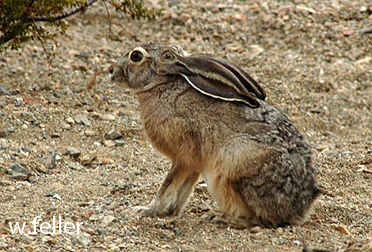
Also see > Mammal: Prey: Herbivore: Nocturnal
Habitat:
Desert Wash
|
Wildlife Watching * Successful wildlife viewing requires a few simple tricks. Click here to find out what they are. |
|
The Desert Food Chain * Everything has its niche. Who eats what, and what eats who in the desert? Click here to find out what more. |
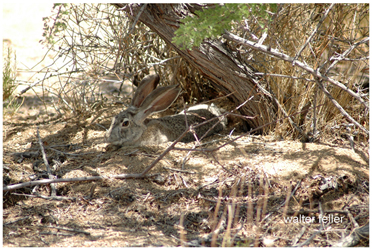
Jackrabbit takes a day off
